

This is a case study, not a claim that AI has replaced literary translators.
We translated Lao She's essay Longing for Beiping (想北平) with GoodTrans and compared the result with the well-known English version by Zhang Peiji. Two independent AI reviewers then assessed the excerpts without being told which version was produced by GoodTrans.
The point is not to declare a universal winner. The point is to make the translation choices visible.
The test setup
The comparison used three texts:
- Lao She's Chinese original.
- Zhang Peiji's published translation, Fond Memories of Peiping.
- A GoodTrans translation titled Longing for Beiping.
GoodTrans was asked to preserve the essay's voice, imagery, rhythm, and cultural texture. The output was delivered as editable Markdown together with a bilingual review file and a quality report, so every judgment could be checked against the source.
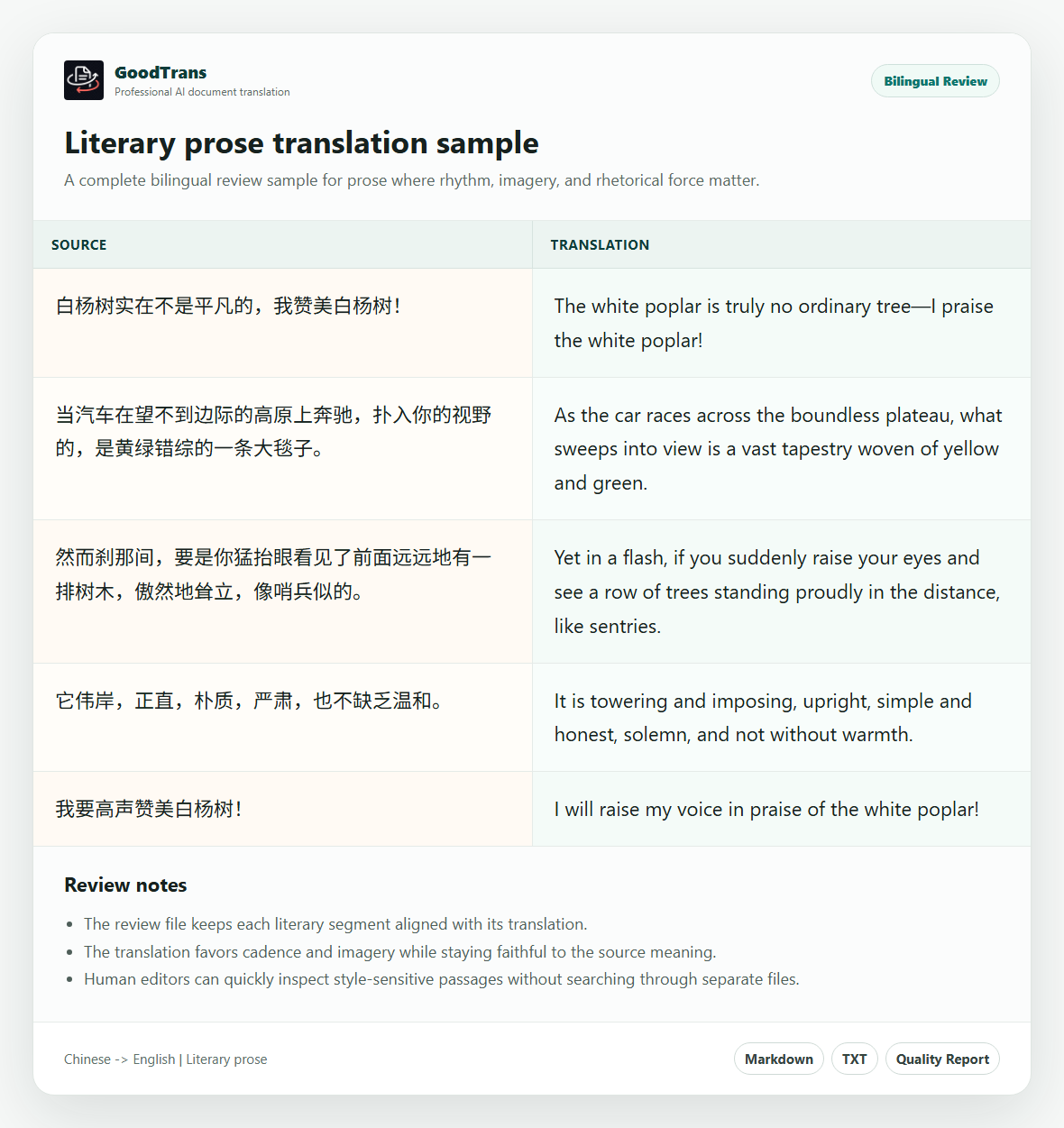
The two reviewers gave the GoodTrans excerpts scores of 95 and 92. The reference translation received 90 in the same evaluation. These are reviewer scores for this test, not an objective ranking of every translation of the essay.
Three choices that reveal the difference
1. “单摆浮搁”
Zhang Peiji renders the sentence in a formal register: “I shall be at a complete loss if I should be called upon to write exclusively about Peiping.”
GoodTrans uses a more conversational line: “But ask me to talk about Beiping straight out, just like that, and I'm at a loss.”
The first version reads like polished literary English. The second keeps the feeling of a speaker hesitating because the subject is too large and too personal. Neither choice is automatically correct; they create different relationships with the reader.
2. The frost-covered plums
The classic version says that American oranges “will pale beside Peiping's plums.” GoodTrans says they “ought to die of shame.”
The phrase “die of shame” is less restrained and more playful. It tries to carry the pride and teasing force of Lao She's Beijing voice instead of turning the comparison into a neutral statement.
3. “牛的一毛”
Zhang Peiji chooses “a mere drop in the ocean,” an idiom that is immediately clear to English readers. GoodTrans stays closer to the image: “a single hair on an ox.”
This is the central question in literary translation: should a translator make the image familiar, or let the reader feel its original cultural shape? GoodTrans does not remove that choice. It makes the choice explicit and leaves it ready for human review.
What this case actually demonstrates
This comparison does not prove that an AI translation is always better than a human translation. It demonstrates something more useful:
- AI can produce more than a literal first pass when the prompt preserves voice and imagery.
- Different translation philosophies can both be defensible.
- A bilingual review file makes style-sensitive passages faster to inspect.
- A long-document workflow needs terminology and structure checks in addition to fluent sentences.
For a serious literary project, a human editor should still decide where to preserve strangeness, where to explain a cultural reference, and which version best serves the intended audience.
Why GoodTrans publishes the full comparison
GoodTrans is designed for long documents, not isolated sentences. The workflow combines reflection-based translation, terminology consistency, editable Markdown and TXT delivery, bilingual review, and a document-level quality report. Publishing both strengths and limitations is part of the product test.
If you have an essay, book chapter, research document, or other long text that needs a review-ready translation, you can try GoodTrans with the current free trial credits. For larger projects, review the pricing options before uploading.
The reviewer scores in this article are observations from one controlled comparison. They should not be read as a certification, a publisher's endorsement, or a claim that AI universally outperforms professional human translators.
