

Mao Dun's In Praise of the White Poplar (白杨礼赞) is a useful stress test for literary translation. The essay is not difficult only because of vocabulary. Its central images carry historical, political, and emotional weight, and a small change in register can change the meaning of the entire passage.
We translated the essay with GoodTrans and compared it with Zhang Peiji's established English translation. Two independent AI reviewers then scored representative passages. The results were close, and that is exactly why the case is worth publishing.
A fair comparison, not a victory lap
In one review, Zhang Peiji's version received 92 and GoodTrans received 91.5. In another, GoodTrans received 96 and the reference translation received 90. The reviewers disagreed about the winner because the two versions make different choices.
That disagreement is more informative than a single headline score. It shows that literary quality is not one number. Accuracy, rhythm, imagery, historical register, and readability can pull in different directions.
“伟丈夫”: giant or noble, upright man?
Mao Dun calls the white poplar “树中的伟丈夫.” Zhang Peiji translates the line as “They are giants among trees!” GoodTrans chooses “it is a noble, upright man among trees!”
“Giants” gives an English reader a clean and powerful image. “A noble, upright man” keeps the human metaphor in the Chinese original. In the historical context of the essay, the tree is connected to farmers, soldiers, and the moral character of ordinary people. GoodTrans chose to keep that human dimension visible.
This is not a simple matter of literal versus free translation. It is a decision about what the reader should notice first: the tree's size, or the human ideal represented by the tree.
Two more choices
Language hammered into shape
For “经过锤炼的语言的精华,” the classic version uses “a linguistic gem sanctioned by long usage.” GoodTrans uses “the distilled essence of language hammered into shape.”
The reference version is elegant and compact. The GoodTrans version keeps the physical image of hammering, which echoes the essay's forceful, sculptural tone.
The repeated challenge
The essay's climactic questions can be rendered as “How could you...” or as the more urgent “Can you not...” GoodTrans keeps the repeated challenge visible instead of smoothing it into one formal rhetorical pattern.
The choice is a reminder that consistency is not always repetition of the same English phrase. Sometimes consistency means preserving the emotional movement of the original.
Where the AI version still needs judgment
The reviewers also identified weaknesses. One noted that rendering “纵横决荡” as “crisscrossing struggles” loses some of the original's battlefield momentum. We agree with that criticism.
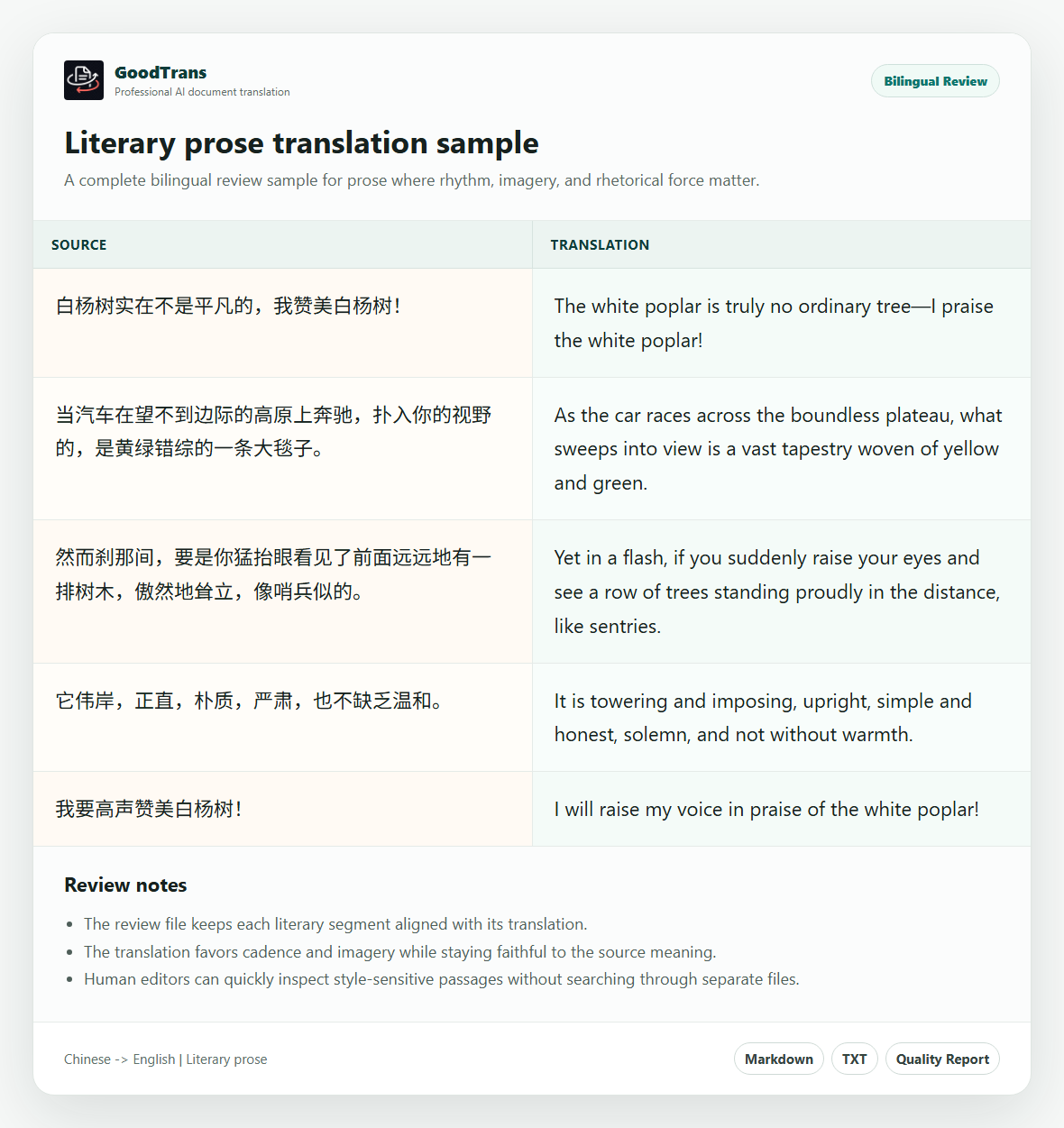
This is why GoodTrans delivers more than a fluent paragraph. The workflow produces editable Markdown, a bilingual review file, and a quality report so an editor can find style-sensitive or culturally loaded passages quickly. The system prepares a strong working translation; a human still decides what is ready for publication.
What long-document translation adds
An isolated sentence can look excellent while the full document drifts. A long literary translation must also preserve:
- recurring images and key terms
- paragraph rhythm and rhetorical escalation
- names, dates, and historical references
- Markdown or document structure
- a consistent editorial register
GoodTrans is built around that document-level problem. It combines reflection-based translation, terminology checks, structure preservation, and review-ready delivery for long essays, reports, manuals, and other serious documents.
You can try GoodTrans with a short excerpt first, or read the existing translation showcases before submitting a longer document.
The scores in this article come from two independent AI review passes of this comparison. They are not a publisher's endorsement and do not establish that AI universally outperforms professional human translation.
