
If you are searching for how to translate a book, you probably already know that book translation is not just "changing words into another language."
A book has rhythm. It has structure. It may have recurring terminology, character names, chapter titles, citations, dialogue style, or technical references. A careless translation can sound fluent sentence by sentence while quietly damaging the author's voice, losing details, or breaking the manuscript structure.
That is why translating a book with AI should not be treated like a single prompt. For serious long-form work, you need a workflow: prepare the manuscript, define the audience, preserve structure, manage terminology, translate in a controlled process, and review the final result side by side with the source.
This guide explains how to translate a book with AI without losing voice, meaning, or formatting. Translating into one specific language pair has its own playbook — see the guide to translating a book into Spanish.
What Makes Book Translation Different from Short Text Translation
Short text translation is usually simple. You paste a paragraph, get a result, and quickly judge whether it sounds right.
Book translation is different because quality must hold across many pages. A good translation needs consistency from the first chapter to the last. Names should not drift. Terms should not change halfway through. The tone should not suddenly become more casual, more academic, or more mechanical unless the source text does.
For fiction, this means preserving atmosphere, pacing, imagery, dialogue, and cultural texture.
For nonfiction, it means preserving logic, terminology, references, numbers, headings, and citations.
For business or technical books, it also means keeping the translation useful for real readers, not just grammatically acceptable.
In other words, book translation is not only a language task. It is a long-document quality control problem.
Step 1: Define the Audience, Purpose, and Translation Style
Before translating a manuscript, define who the translation is for.
A literary novel translated for English-speaking readers needs a different style from a technical manual translated for internal use. A self-published business book may need clarity and authority. A fantasy novel may need atmosphere and consistent worldbuilding. A research monograph may need precision and citation integrity.
Before you start, answer these questions:
- Who will read the translated book?
- Is the goal publication, internal review, research, localization, or market testing?
- Should the translation feel literary, academic, technical, commercial, or plain-language?
- Should names, cultural terms, and special concepts be translated, explained, or preserved?
- Are there terms that must stay consistent throughout the book?
This step matters because "accurate" does not mean the same thing in every genre. A literal translation may be acceptable for some technical content, but it can destroy the voice of a novel. A smooth translation may feel pleasant, but it can become dangerous if it rewrites facts, numbers, or technical terms too freely.
Step 2: Prepare Your Manuscript Before Translation
A clean source file produces a better translation.
Before using any AI book translation workflow, remove obvious noise from the manuscript. Check for repeated headers, broken page numbers, OCR errors, footers, corrupted characters, or unrelated pasted content. These problems may look small, but in long texts they can confuse segmentation, terminology extraction, and final review.
The best input formats are usually:
- TXT for plain manuscripts
- Markdown for structured long-form text
- PDF when extraction is necessary
- pasted text for shorter sections or chapter-level tests
If your source is a PDF, remember that PDF is often a display format, not a clean writing format. The text may need extraction before translation. If the PDF contains scanned pages, OCR quality becomes important.
Why Formatting Breaks in Standard AI Tools
Many people try to translate a book by copying chapters into a chat interface. This often works for a few pages, then breaks down.
Common problems include:
- headings moved or removed
- paragraph breaks lost
- tables collapsed
- footnotes mixed into body text
- chapter structure weakened
- incomplete output caused by AI truncation limits
- inconsistent terminology across sessions
This is the copy-paste trap. It feels fast at first, but the hidden cleanup cost grows quickly.
Why Markdown and TXT Are Often Better for Long Documents
For translation, simple structure is often stronger than complex layout.
Markdown and TXT are useful because they keep the text editable and easier to inspect. Markdown can preserve headings, lists, emphasis, links, and basic structure without forcing the translation workflow to fight a heavy page layout.
This does not mean the final book must be published as Markdown or TXT. It means these formats are often safer during translation and review.
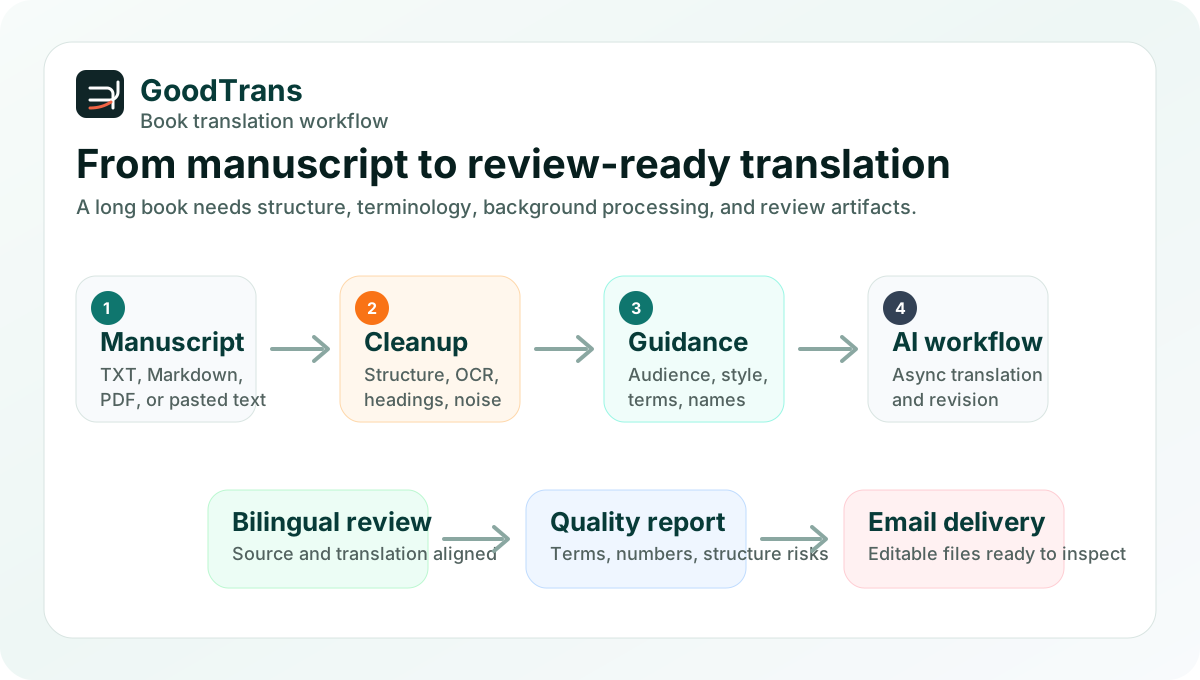
A book translation workflow should preserve structure before, during, and after the AI translation step.
Step 3: Choose a Workflow, Not Just an AI Model
A powerful AI model is helpful, but it is not enough.
The real question is whether your process can handle a full manuscript reliably. Long texts need segmentation, context, terminology control, review artifacts, and failure recovery. Without those, even a strong model can produce incomplete or inconsistent output.
A serious AI book translation workflow should:
- accept the full manuscript or large chapters
- split the text by structure, not random chunks
- preserve headings, lists, numbers, and links
- apply terminology guidance across the document
- run asynchronously instead of depending on a browser tab
- generate review-ready files after completion
For book-length work, the workflow matters as much as the translation engine.
The Copy-Paste Trap and AI Truncation Limits
AI truncation limits are one of the biggest reasons book translation fails in ordinary chat tools.
A long chapter may exceed the tool's context or output limits. The model may stop early, summarize instead of translate, skip paragraphs, or silently omit sections. The output may look polished, but the reader has no easy way to know whether everything was translated.
That is why long-document translation should not rely on manual copy-paste. You need a workflow that can track the full text, process it in controlled sections, and preserve enough structure for review.
Why Long Book Translation Should Run Asynchronously
Book translation takes time. A high-quality workflow should not require the user to stare at a page while a long task runs.
Asynchronous translation is better for large manuscripts because the system can process the document in the background and deliver the result when it is ready. This is especially important for long files, PDF extraction, glossary handling, and review package generation.
If you want to avoid manual copy-paste, format breaking, and incomplete output, GoodTrans is built around an asynchronous long-document translation workflow. It delivers editable translation files, a bilingual review file, and a quality report by email.
Step 4: Preserve Voice, Tone, Terminology, and Structure
The biggest risk in book translation is not always obvious mistranslation. Sometimes the translation is readable but no longer feels like the same book.
For literary translation, quality depends on voice. The translation should preserve rhythm, dialogue tone, atmosphere, imagery, and emotional pacing. A novel should not sound like a technical manual. A mythic or historical passage should not become flat modern prose unless that is the intended style.
For technical or nonfiction translation, quality depends on precision. Terms, references, numbers, units, headings, and logical structure must stay stable.
Literary Translation: Rhythm, Dialogue, and Atmosphere
When translating fiction, give the workflow style guidance before translation begins.
For example:
Translate this as literary fiction. Preserve atmosphere, pacing, imagery, dialogue tone, and culturally specific language. Avoid overly literal sentence structure. Do not over-explain symbolic terms unless the meaning would be unclear.
This kind of instruction helps the translation avoid a common failure: grammatically correct but lifeless prose.
Technical or Nonfiction Translation: Terms, Numbers, and References
For technical books, consistency is more important than elegance.
Prepare a glossary if the manuscript contains specialized terms, product names, legal concepts, academic terminology, or recurring phrases. Even a small glossary can reduce term drift across chapters.
A good workflow should also help check:
- numbers and dates
- links and references
- headings and subheadings
- repeated technical terms
- lists and tables
- untranslated source-language fragments
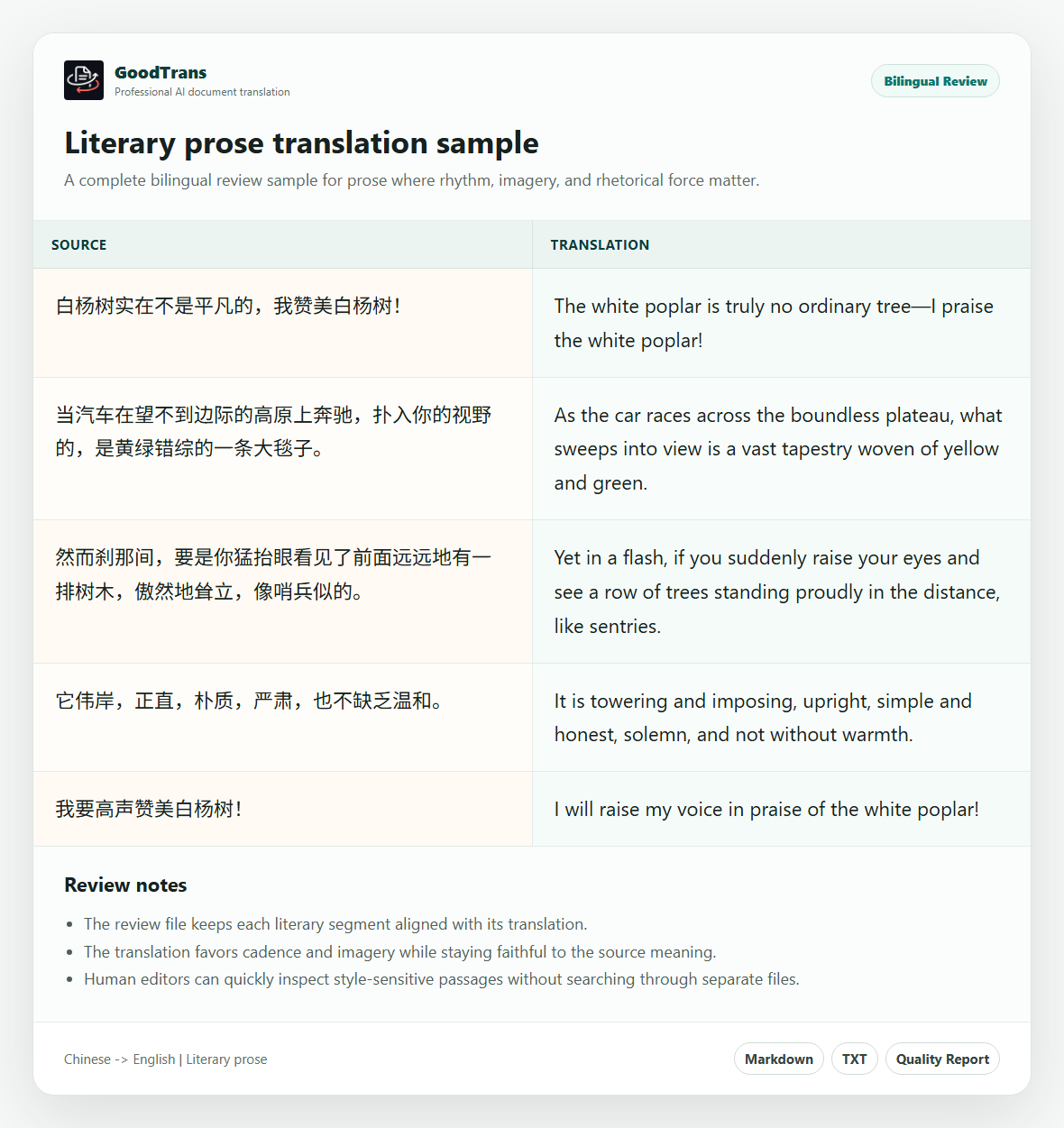
A bilingual review file helps authors and editors compare the source and translation paragraph by paragraph.
Step 5: Review the Translation Before Publishing
Never publish raw AI output without review.
Even strong AI translation can contain omissions, tone issues, inconsistent terminology, or formatting damage. The problem is that many of these issues are hard to see if you only read the translated file.
That is why a bilingual review file is so useful.
Why You Need a Side-by-Side Bilingual Review File
A side-by-side bilingual review file lets you compare the original and translated text paragraph by paragraph.
This makes it much easier to check:
- whether anything was skipped
- whether names and terms stayed consistent
- whether paragraph structure was preserved
- whether the tone matches the original
- whether important details were softened or changed
For serious book translation, reviewability is not optional. It is part of quality.
GoodTrans has published two Chinese-to-English literary translation cases so authors and editors can inspect voice, imagery, rhetorical structure, bilingual review, and known limitations before trying a long document.
How to Use a Translation Quality Report
A quality report should help you inspect risk areas quickly.
It does not replace human judgment, but it can point attention to possible problems such as missing content, terminology shifts, suspiciously short sections, broken links, or number mismatches.
For authors and publishers, this is especially valuable because the goal is not simply to "get a translation." The goal is to produce a manuscript that can be edited, reviewed, and prepared for real use.
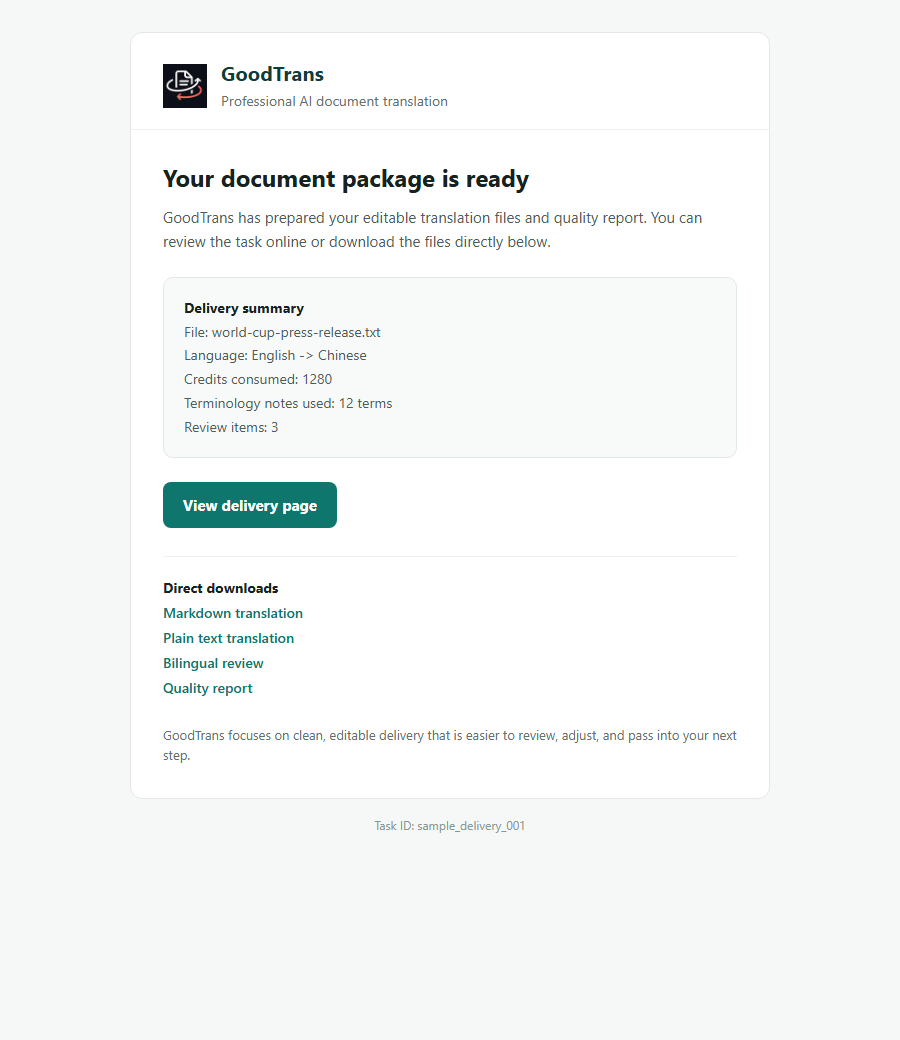
GoodTrans delivers editable files, bilingual review, and a quality report so the translation can move into review instead of getting stuck in a chat window.
Common Mistakes When Translating a Book with AI
The most common mistake is treating a book like a long chat message.
Other mistakes include:
- translating chapter by chapter without shared terminology
- skipping manuscript cleanup before translation
- ignoring the target audience and style
- trusting fluent output without checking omissions
- using PDF input without checking extraction quality
- losing headings, lists, or footnotes
- failing to review names, numbers, and references
- publishing without bilingual comparison
AI can greatly speed up book translation, but only when the process is designed for long-form quality.
FAQ
Can I use ChatGPT to translate a whole book?
You can use ChatGPT or similar tools for parts of the process, but translating a whole book through manual copy-paste is difficult. Long manuscripts can run into truncation limits, context loss, inconsistent terminology, and fragmented review.
What is the best AI tool for long document translation?
The best tool is not just the one with the strongest model. For long documents, the best tool is the one that supports structure preservation, terminology consistency, asynchronous processing, bilingual review, and quality reporting.
How do I translate a book without losing formatting?
Start with a clean source file, preserve headings and paragraph structure, avoid random copy-paste chunks, and review the translation in a bilingual file before publishing. For many workflows, Markdown or TXT is safer than complex layout formats during translation.
How do I preserve the author's voice in translation?
Define the target style before translation begins. For literary work, include guidance about tone, rhythm, imagery, dialogue, and cultural terms. Then review sample passages before translating the whole book.
How long does it take to translate a book with AI?
It depends on manuscript length, file quality, language pair, review depth, and whether PDF extraction is needed. AI can make the process much faster than traditional manual translation, but serious book translation still needs time for quality review.
Can AI translation replace human editors?
AI can produce a strong first translation and reduce manual workload, but human review is still important for publication-level work. The best results usually come from combining AI translation with structured review.
Final Recommendation: Use AI, But Use a Real Workflow
If you want to translate a book, do not rely on a single prompt and a browser tab.
Use AI, but use it inside a workflow that respects long-form writing: manuscript preparation, terminology consistency, structure preservation, asynchronous processing, bilingual review, and quality reporting.
That is the difference between a quick translation draft and a review-ready book translation.
GoodTrans is designed for this exact use case: long-document translation for authors, researchers, publishers, and professionals who need more than a short text translator.
You can test the workflow here:
Start a GoodTrans book translation test
New users receive 3,000 trial credits, enough to test the workflow on a short real document or a sample chapter.
